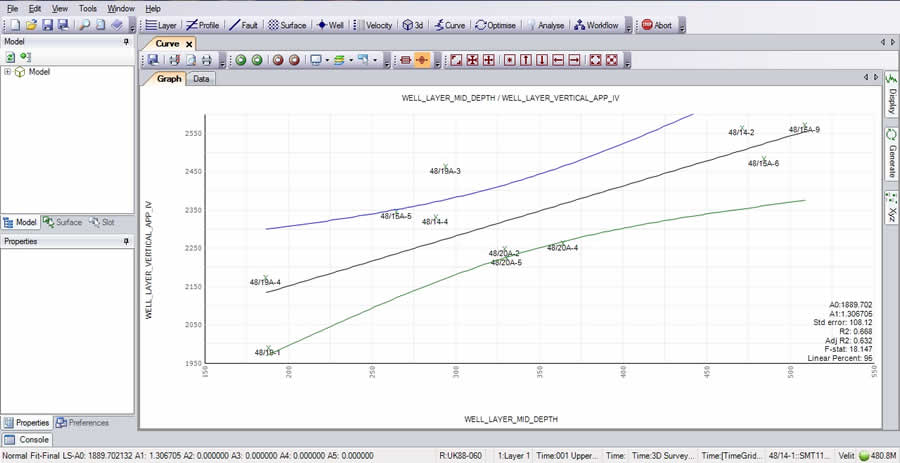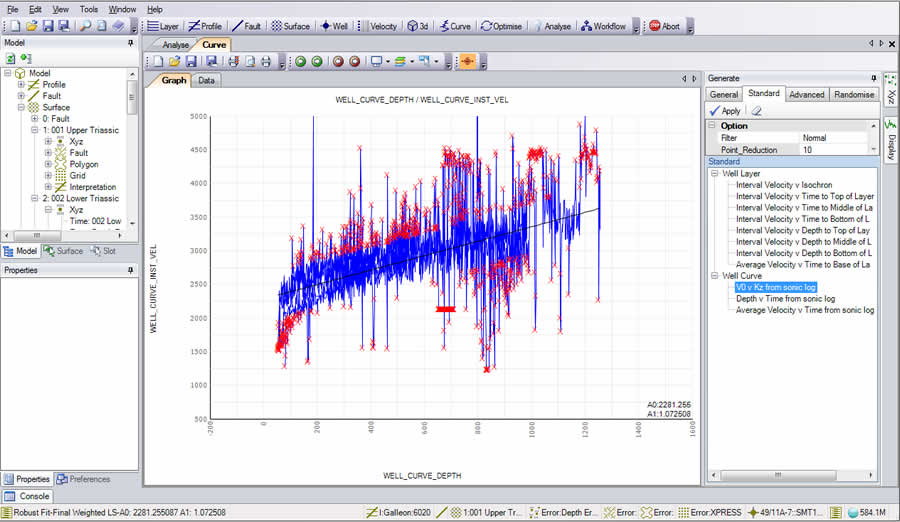
The Curve Module in Velit depth conversion software is a powerful tool designed to handle and manipulate well log data, which is crucial for accurate depth conversion and subsurface modeling in the oil and gas industry. The Curve Module in Velit allows users to import, edit, analyze, and apply these well log curves to enhance the accuracy of depth models.
Key Features and Capabilities of the Curve Module in Velit
- Data Import and Management:
- The Curve Module enables users to import well log data from various sources and formats, such as LAS (Log ASCII Standard) files. This flexibility ensures that users can integrate data from different vendors and sources into a unified workflow.
- Once imported, the module provides tools for organizing and managing these logs within the Velit project. Users can categorize logs by well, depth interval, or property type, making it easier to access and work with the data.
- Curve Editing and Manipulation:
- The Curve Module offers a suite of editing tools that allow users to clean and correct well log data. This might include removing outliers, interpolating missing values, smoothing noisy data, or applying depth shifts to align logs with other subsurface data.
- Users can also perform mathematical operations on the curves, such as averaging, scaling, or combining different logs to derive new curves that might represent composite properties like effective porosity or net-to-gross ratios.
- Curve Analysis and Interpretation:
- Velit’s Curve Module includes analytical tools for interpreting well log data. These tools can generate cross-plots, histograms, and other statistical analyses that help users understand the relationships between different properties and identify trends or anomalies.
- For example, users can analyze the relationship between acoustic velocity and density to derive a velocity model that can be used in the depth conversion process. This analysis is essential for creating accurate depth models that reflect the true subsurface geology.
- Integration with Depth Conversion:
- One of the primary functions of the Curve Module is to integrate well log data into the depth conversion workflow. Well logs provide critical inputs for velocity models, which are used to convert seismic time data into depth data.
- The Curve Module allows users to calibrate velocity models with well log data, ensuring that the depth conversion results are consistent with the observed geological properties in the wells. This calibration is crucial for reducing uncertainty and improving the accuracy of subsurface models.
- Multi-Well Analysis:
- Velit’s Curve Module supports the analysis of multiple wells simultaneously. This capability is particularly useful in field-wide studies, where understanding the spatial variability of subsurface properties across a reservoir is important for exploration and development.
- Users can compare and contrast well logs from different wells, identify regional trends, and incorporate these trends into their depth conversion and reservoir modeling efforts.
- Visualization Tools:
- The Curve Module includes powerful visualization tools that allow users to display well log curves alongside other subsurface data, such as seismic sections or depth models. This integration of visual data aids in the interpretation process and helps users make more informed decisions.
- These visualizations can be customized, with users able to adjust the scales, color schemes, and layouts to highlight specific aspects of the data. For instance, overlaying a velocity curve on a seismic section can help correlate seismic reflections with geological layers.
Applications of the Curve Module in the Oil and Gas Industry
- Velocity Model Calibration:
- The primary use of the Curve Module is in the calibration of velocity models for depth conversion. By integrating well log data with seismic data, geophysicists can create more accurate depth models that better represent the subsurface geology.
- Reservoir Characterization:
- The Curve Module is also valuable in reservoir characterization. Well logs provide detailed information about reservoir properties, such as porosity, permeability, and fluid saturation. Analyzing and interpreting these curves helps in defining the quality and extent of the reservoir, guiding drilling and production decisions.
- Petrophysical Analysis:
- Petrophysicists can use the Curve Module to derive and analyze petrophysical properties from well logs. For example, the module can be used to calculate shale volume, water saturation, or rock mechanical properties, which are critical for both exploration and production activities.
- Cross-Disciplinary Collaboration:
- The Curve Module facilitates collaboration between geophysicists, geologists, and engineers by providing a common platform for analyzing well log data. This cross-disciplinary approach ensures that all relevant data is integrated into the subsurface model, improving its accuracy and reliability.
Conclusion
The Curve Module in Velit is a comprehensive tool for handling, analyzing, and integrating well log data into the depth conversion and subsurface modeling processes. By providing robust data management, editing, analysis, and visualization capabilities, the Curve Module enhances the accuracy of subsurface models and supports better decision-making in the exploration and development of oil and gas reservoirs. As the industry continues to evolve and face new challenges, tools like Velit’s Curve Module will remain essential for optimizing the use of well log data in geophysical and geological workflows.