
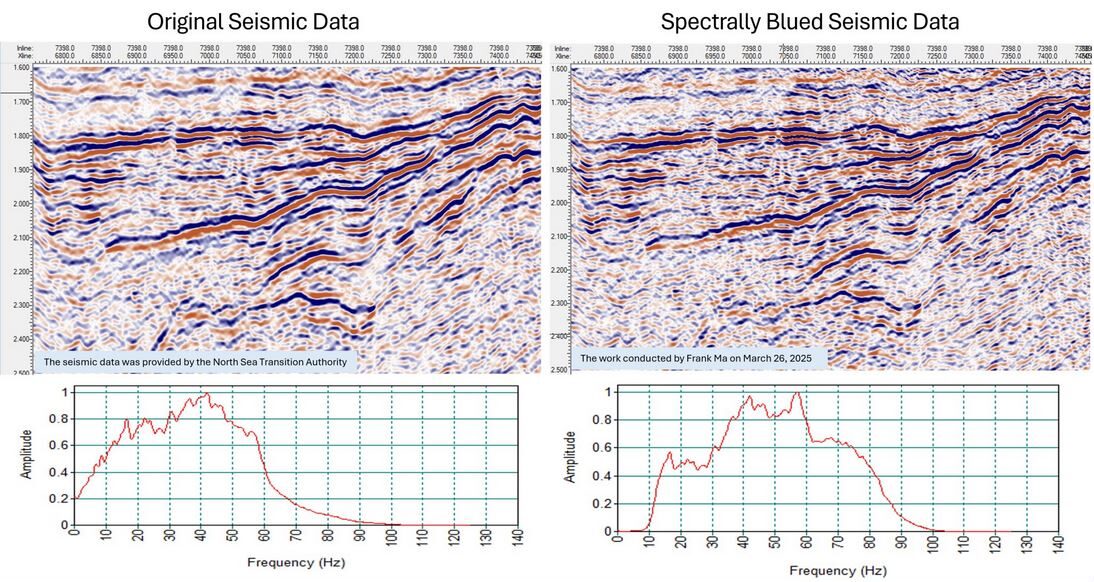
As geoscientists, we strive to extract more detail from seismic data to understand the subsurface. A powerful technique making waves in seismic processing is spectral blueing. Let’s explore its definition, benefits, workflow, parameter setup, and applications.
What is Seismic Spectral Blueing?
Spectral blueing enhances seismic data resolution by extending its bandwidth, especially high frequencies. Seismic data often has a limited bandwidth (for example 5–70 Hz) due to the Earth’s filtering, which attenuates higher frequencies. Spectral blueing shapes the seismic spectrum to match a “blue” reflectivity spectrum (amplitude rising with frequency), derived from well logs. The result is sharper images revealing thinner beds and subtle features.
Benefits of Spectral Blueing
- Improved Resolution: Boosting high frequencies enhances vertical resolution, resolving thinner layers which is key for reservoir characterisation.
- Better Fault Imaging: Small-scale faults and fractures become clearer, aiding structural interpretation.
- Enhanced Stratigraphy: Subtle features like channels or pinch-outs are better defined.
- Data-Driven: Uses well logs to ensure geological accuracy, avoiding noise amplification.
Workflow for Spectral Blueing
- Analyse Seismic Spectrum: Examine the amplitude spectrum to identify usable bandwidth and where signal drops to noise.
- Derive Target Spectrum: Use well logs to compute a “blue” reflectivity spectrum to guide enhancement.
- Design Blueing Operator: Create a filter to match the target spectrum, boosting high frequencies.
- Apply and QC: Apply the filter, ensuring no noise amplification or artefacts.
Setting Up Parameters: Extending High-Frequency Values
A key parameter is the high-frequency limit:
- Assess Signal-to-Noise Ratio: Check where the signal becomes noise-dominated (for example, amplitude near zero at 90 Hz).
- Set High-Frequency Target: Choose a boost limit (for example, 80–90 Hz if bandwidth ends at 70–80 Hz) to enhance signal, not noise.
- Control Boost Strength: Adjust the filter for a gradual boost, tapering off beyond the target.
- Validate with Well Data: Ensure the spectrum aligns with well-derived reflectivity.
Applications of Spectral Blueing
- Reservoir Characterisation: Resolves thin units for better volumetrics.
- Complex Geologies: Images subtle features in carbonates or clastics.
- 4D Seismic: Enhances time-lapse data to detect reservoir changes.
- Unconventionals: Identifies fractures in shale for well placement.
Seismic spectral blueing is nearly the same process as coloured inversion, except that coloured inversion uses an impedance log to shape the seismic spectrum, while spectral blueing uses a reflection coefficient log as a guide, with both sharing a similar workflow.
Written by:
Frank (Xin-Quan) Ma (PhD) Senior R & D Geophysicist at Equipoise Software Limited