
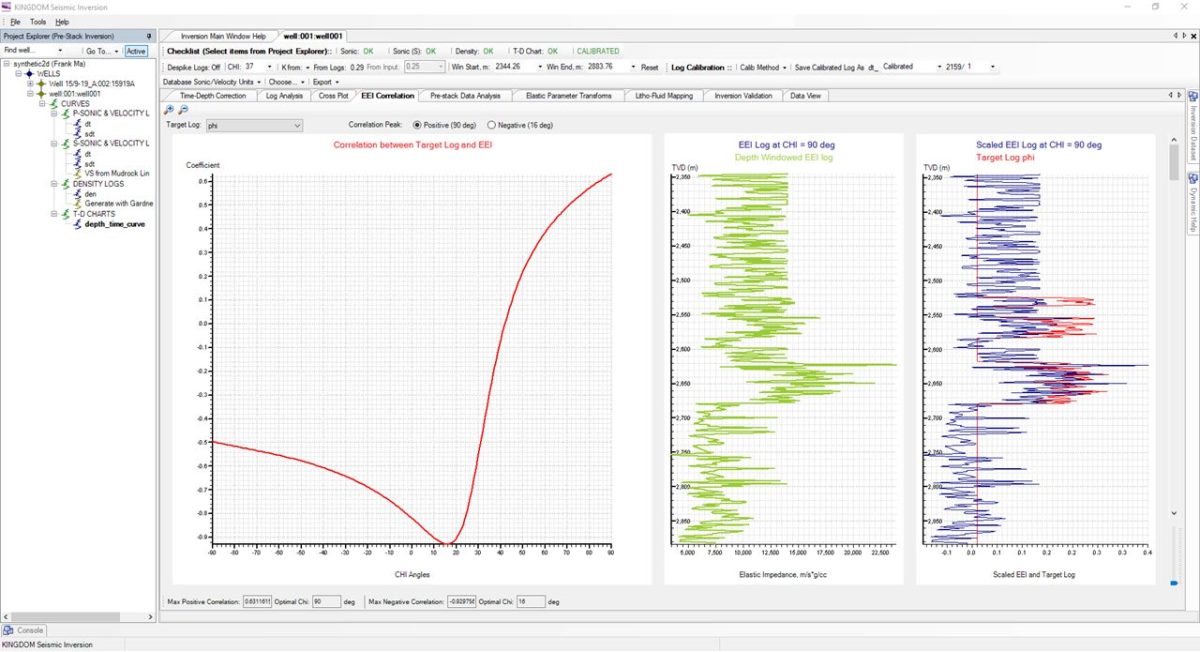
Extended Elastic Impedance (EEI) in the context of seismic inversion is a technique used to enhance the interpretation of subsurface properties by extending the concept of Acoustic Impedance (AI) and Elastic Impedance (EI) into a broader domain. EEI is particularly useful in identifying lithology and fluid types within a reservoir, which are crucial for accurate reservoir characterization in the oil and gas industry.
What is Extended Elastic Impedance (EEI)?
EEI extends the idea of elastic impedance by allowing the impedance to be calculated at different incidence angles, rather than just at the normal (zero) incidence. This flexibility enables geophysicists to target specific rock properties, such as fluid content or lithology, by selecting an optimal angle that best highlights the contrasts in these properties.
Key Concepts:
- Elastic Impedance (EI): A generalization of acoustic impedance, EI incorporates both P-wave and S-wave information and can be calculated at any angle of incidence. EI is sensitive to changes in lithology and fluid content in the subsurface.
- Extended Elastic Impedance (EEI): EEI builds on EI by introducing a mathematical framework that allows for the continuous variation of the incidence angle. By adjusting this angle, geophysicists can create EEI volumes that emphasize specific properties, such as fluid saturation or rock stiffness.
How EEI is Used in Inversion
EEI can be integrated into the seismic inversion process, where seismic data is inverted to obtain a 3D model of subsurface properties. Here’s how EEI is typically used in inversion:
- Selection of Optimal Angle (χ angle):
- In EEI, the first step is to determine the optimal χ (chi) angle. This angle is selected based on the specific property of interest, such as distinguishing between different types of fluids (oil, gas, water) or between rock types (sandstone, shale).
- The χ angle can be found through crossplot analysis of well log data, where different rock or fluid types plot in distinct regions when using certain χ angles.
- Creation of EEI Logs:
- Once the optimal χ angle is determined, EEI logs are generated from well log data. These logs represent the impedance at the chosen angle and are used as a reference for seismic inversion.
- Seismic Inversion:
- The seismic inversion process is then carried out using these EEI logs. In this step, seismic data is inverted to produce a 3D volume that matches the EEI log characteristics.
- The resulting EEI volumes provide a clearer image of the subsurface compared to traditional acoustic or elastic impedance volumes because they are tailored to highlight specific properties.
- Interpretation and Analysis:
- The EEI volumes are analyzed to interpret subsurface properties. For instance, a specific EEI volume might be used to map areas of high fluid saturation or to distinguish between different lithologies.
- This interpretation helps in identifying reservoir zones with better accuracy, which is critical for exploration and development planning.
Advantages of Using EEI in Inversion
- Enhanced Sensitivity to Rock Properties:
- EEI provides greater sensitivity to specific rock and fluid properties compared to traditional impedance methods. By selecting the appropriate χ angle, geoscientists can tailor the impedance to better highlight contrasts between different subsurface features.
- Improved Reservoir Characterization:
- The ability to target specific properties with EEI enhances the characterization of the reservoir, leading to more accurate predictions of reservoir quality, fluid distribution, and production potential.
- Reduced Ambiguities:
- Traditional seismic inversion can sometimes struggle with ambiguities in the interpretation of lithology and fluid content. EEI reduces these ambiguities by providing clearer differentiation between different subsurface materials.
- Integration with Other Data:
- EEI can be integrated with other geophysical and geological data, such as well logs, to create more comprehensive and accurate subsurface models. This integration is essential for reducing uncertainty in reservoir models.
Applications of EEI in the Oil and Gas Industry
- Fluid Discrimination:
- EEI is particularly useful in distinguishing between different fluid types within a reservoir. By selecting a χ angle that highlights fluid-related contrasts, geoscientists can more accurately map oil, gas, and water zones.
- Lithology Identification:
- EEI helps in differentiating between various lithologies, such as distinguishing between sandstone and shale. This capability is crucial for understanding the depositional environment and predicting reservoir quality.
- Enhanced Exploration and Development:
- The detailed subsurface information provided by EEI volumes supports better decision-making in exploration and development activities. Companies can optimize well placements, reduce drilling risks, and improve recovery strategies based on the enhanced reservoir models provided by EEI inversion.
- Unconventional Reservoirs:
- In unconventional plays, such as shale gas or tight oil, EEI can be used to identify sweet spots—areas with higher porosity and permeability that are more likely to produce hydrocarbons. This application is critical for optimizing the development of unconventional resources.
Conclusion
Extended Elastic Impedance (EEI) in inversion is a powerful tool for enhancing the interpretation of seismic data by providing tailored impedance volumes that highlight specific subsurface properties. Through the careful selection of the χ angle and integration into the inversion process, EEI allows geoscientists to create more accurate and detailed models of the subsurface. These models are invaluable for reservoir characterization, fluid discrimination, and overall exploration and production optimization in the oil and gas industry.