
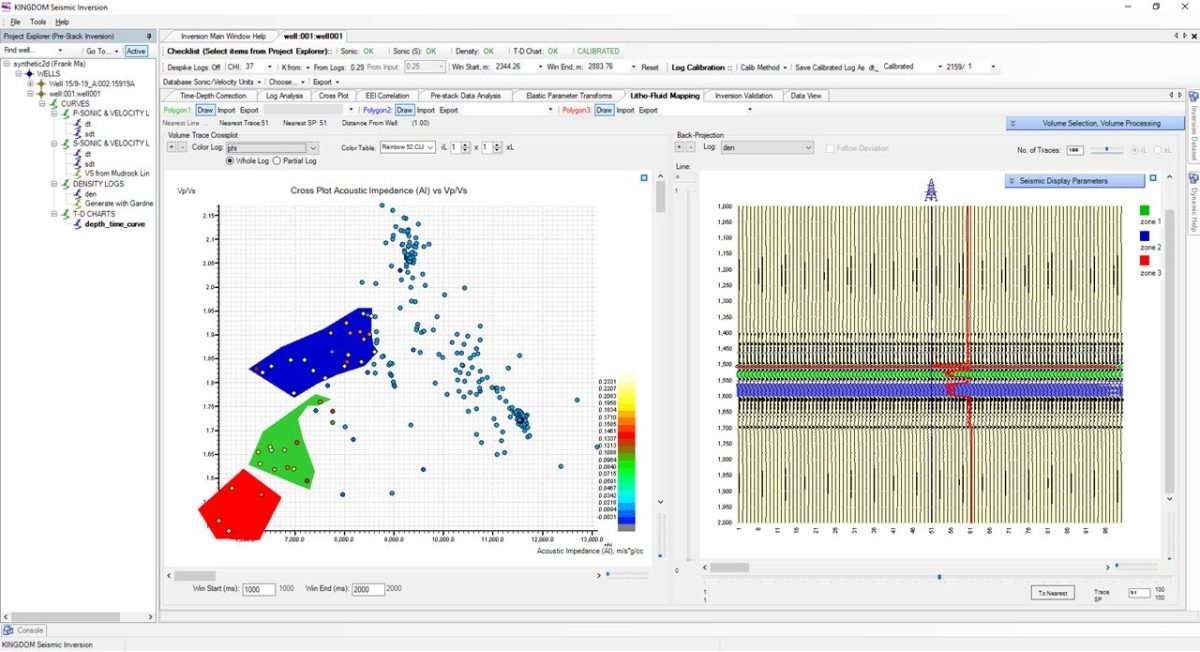
Prestack inversion is a sophisticated seismic inversion technique that directly utilizes seismic data before it has been stacked (i.e., before the seismic traces from different shot points have been combined into a single trace). This approach is highly valuable in the oil and gas industry as it provides more detailed and accurate subsurface information compared to traditional poststack inversion methods.
Overview of Prestack Inversion
Prestack inversion involves inverting seismic data collected at various angles of incidence or offsets (the distance between the source and receiver). By analysing this data before it is stacked, prestack inversion allows for the extraction of more comprehensive subsurface properties, such as P-wave impedance, S-wave impedance, and density. These properties are critical for characterizing lithology, identifying fluid content, and understanding reservoir properties.
Key Steps in Prestack Inversion
- Data Preparation:
- The first step involves gathering prestack seismic data, which includes common midpoint (CMP) gathers where traces are sorted by their reflection points and recorded at different offsets.
- Preprocessing of this data is crucial to remove noise, correct for NMO (normal moveout), and apply other necessary adjustments to ensure that the data is suitable for inversion.
- Model Building:
- A background geological model is built, typically using well data, to provide initial estimates of the subsurface properties. This model is essential for guiding the inversion process.
- The model includes information on P-wave velocities, S-wave velocities, and densities, which serve as a baseline for the inversion.
- Inversion Process:
- Angle-Dependent Reflectivity: Prestack inversion relies on the variation of reflectivity with angle (or offset). By analysing how seismic amplitudes change with different angles, the inversion process can differentiate between the contributions of P-waves, S-waves, and density to the seismic signal.
- Simultaneous Inversion: This method simultaneously inverts for multiple properties, such as P-wave impedance, S-wave impedance, and density, rather than handling them separately. Simultaneous inversion helps in reducing ambiguities and ensuring that the final model is consistent with all the available data.
- AVO (Amplitude Versus Offset) Analysis: Prestack inversion often includes AVO analysis, which examines the variation in reflection amplitudes with offset. AVO analysis helps in distinguishing between fluid effects and lithology changes.
- Model Refinement and Iteration:
- The initial inversion results are compared with the observed seismic data, and discrepancies are analysed. The model is then iteratively refined by adjusting parameters until the predicted seismic data closely matches the observed data.
- This iterative process ensures that the final inverted model accurately reflects the true subsurface properties.
- Post-Inversion Analysis:
- After the inversion is completed, the resulting volumes of P-wave impedance, S-wave impedance, and density are analysed to interpret subsurface geology.
- Crossplots and other analytical tools are used to correlate these properties with lithology, fluid content, and other reservoir characteristics.
Advantages of Prestack Inversion
- High-Resolution Subsurface Characterization:
- Prestack inversion provides higher resolution and more detailed subsurface information compared to poststack inversion because it uses the full range of angle-dependent seismic data. This allows for more accurate mapping of lithology, fluid content, and other critical reservoir properties.
- Better Discrimination of Lithology and Fluids:
- By utilizing AVO effects and separating the contributions of different wave modes, prestack inversion is particularly effective at distinguishing between different rock types and fluid contents. This capability is essential for identifying hydrocarbon-bearing zones.
- Improved Accuracy in Complex Geologies:
- In areas with complex geology, such as faulted or fractured reservoirs, prestack inversion offers improved accuracy by taking into account the full range of seismic information. This makes it a powerful tool for exploration in challenging environments.
- Reduction of Ambiguities:
- The simultaneous inversion of multiple parameters helps reduce the ambiguities that can arise when using only poststack data. This leads to more reliable and interpretable results, which are crucial for making informed exploration and development decisions.
Applications of Prestack Inversion in the Oil and Gas Industry
- Reservoir Characterization:
- Prestack inversion is widely used for detailed reservoir characterization, allowing geoscientists to map the distribution of reservoir properties such as porosity, saturation, and lithology with high accuracy.
- Fluid Detection:
- By analysing the relationship between P-wave and S-wave impedances, prestack inversion can effectively identify and differentiate between fluids in the subsurface, such as distinguishing oil, gas, and water zones.
- Unconventional Reservoirs:
- In unconventional plays, such as shale gas and tight oil, prestack inversion helps identify sweet spots—areas with higher porosity and brittleness that are more likely to yield economically viable production.
- AVO and Rock Physics Analysis:
- Prestack inversion is integral to advanced AVO analysis and rock physics studies, which aim to relate seismic response to rock properties. This is essential for predictive modelling and exploration risk reduction.
Challenges and Considerations
- Data Quality:
- The success of prestack inversion heavily depends on the quality of the input seismic data. Poorly processed or noisy data can lead to inaccurate results, making data conditioning and preprocessing critical steps in the workflow.
- Computational Intensity:
- Prestack inversion is computationally intensive due to the large volumes of data and the complexity of the calculations involved. This requires significant processing power and time, which can be a limiting factor in some projects.
- Model Dependence:
- The inversion results are highly dependent on the initial geological model. Inaccuracies in the starting model can lead to incorrect interpretations, so building a robust initial model is crucial.
Prestack inversion is a powerful technique for subsurface characterization that leverages the full range of seismic data before stacking to provide detailed and accurate models of subsurface properties. Its ability to differentiate lithology, fluid content, and other key reservoir characteristics makes it an indispensable tool in the oil and gas industry, particularly for complex reservoirs and unconventional plays. However, it requires high-quality data, careful model building, and significant computational resources to realize its full potential.